
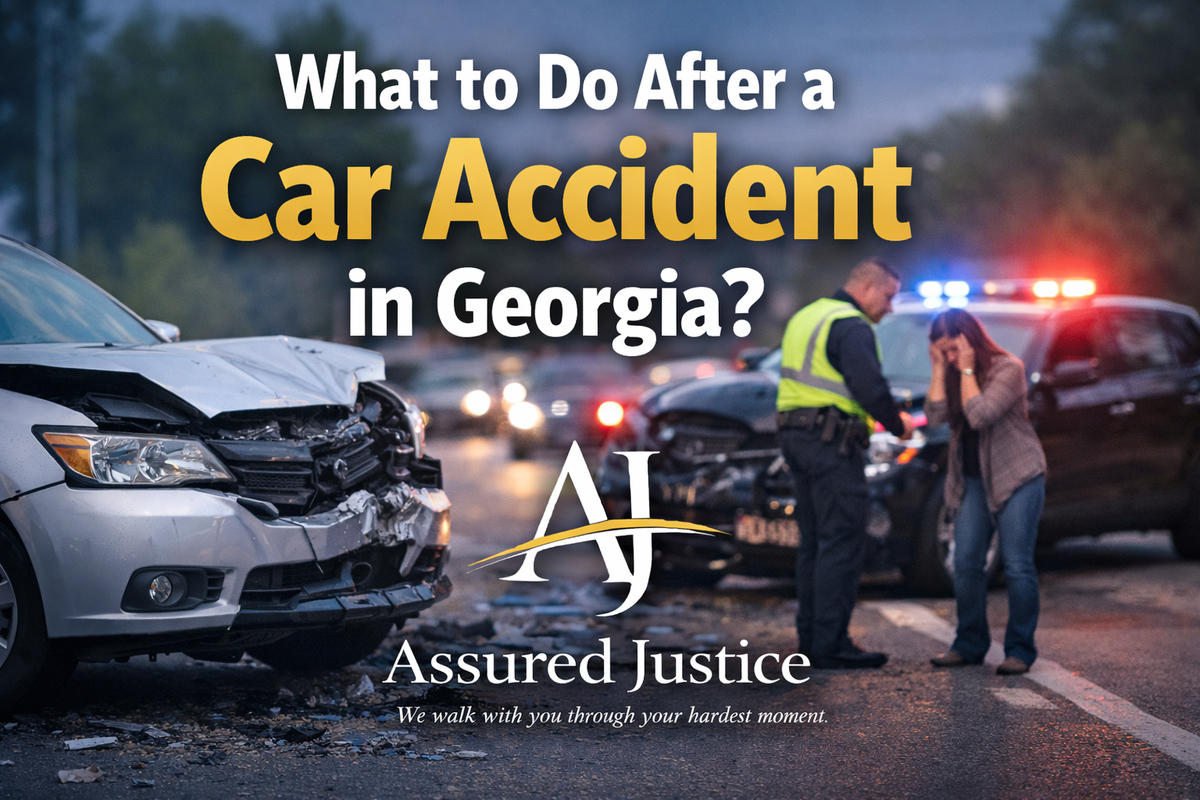
A car accident can happen in an instant—but the decisions you make in the minutes, hours, and days that follow can shape your legal rights for years. Here is what Georgia law requires, and what a careful accident victim should do at every stage.
Immediate Steps at the Scene
Your safety and the safety of others come first. If you can do so without endangering yourself, move to a secure location away from traffic. Turn on your hazard lights and, if you have them, place road flares or reflective triangles to warn other drivers.
Call 911 — Even for Minor Crashes
Georgia law requires that you report any accident involving injury, death, or property damage that renders a vehicle inoperable to law enforcement. O.C.G.A. § 40-6-273 obligates the driver of a vehicle involved in an accident to immediately give notice to the nearest law enforcement agency. A police report creates an official record that is invaluable in any insurance claim or lawsuit that follows.
Check on Everyone Involved
Assess whether anyone in your vehicle or the other vehicle appears injured. Do not attempt to move an injured person unless they face an immediate hazard such as fire — improper movement can worsen spinal injuries. Relay any observed injuries clearly when speaking with the 911 dispatcher.
Exchange Information — But Limit Conversation
Georgia law requires drivers involved in an accident to provide their name, address, vehicle registration, and insurance information to the other party and to police. You are legally obligated to share this information — but you are not obligated to discuss fault, apologize, or speculate about what happened. Even a casual "I'm sorry" can be used as an admission of liability.
Document the Scene Thoroughly
Use your smartphone to photograph and video every vehicle from multiple angles, the point of impact, skid marks, road conditions, traffic signals, weather conditions, and any visible injuries. Capture license plates, street signs, and nearby business names. This raw evidence is often impossible to recreate later and can be decisive in disputed-liability cases.
Identify Witnesses
Ask any bystanders whether they witnessed the crash and request their name and contact information. Independent witness testimony is among the most persuasive evidence in Georgia personal injury litigation, particularly when the other driver disputes how the accident occurred.
Do not leave the scene before law enforcement arrives and releases you — unless you require emergency medical transport. Leaving the scene of an accident involving injury or death is a felony under Georgia law (O.C.G.A. § 40-6-270) and will devastate your civil case as well.
Seek Medical Attention Promptly
Even if you feel fine immediately after the crash, do not delay seeking medical evaluation. The adrenaline response triggered by a collision routinely masks pain from whiplash, soft-tissue injuries, and even traumatic brain injuries. Symptoms may not fully emerge for 24 to 72 hours — or longer in cases of internal injury.
Seeking treatment promptly does two things simultaneously: it protects your health, and it creates a medical record that connects your injuries directly to the accident. Insurance adjusters and defense attorneys actively exploit gaps in treatment. A delay of even a few days without a documented medical reason can be characterized as evidence that your injuries were not serious — or were caused by something else entirely.
Follow every treatment recommendation your physician makes. Missed appointments and discontinued physical therapy are routinely used to minimize the value of personal injury claims in Georgia courts.
What to Do in the Days That Follow
Notify Your Insurance Company
Report the accident to your own insurer promptly. Most Georgia auto insurance policies contain a cooperation clause requiring timely reporting. Failing to notify your insurer can give them grounds to deny coverage — even when you are not at fault. Provide factual information about what occurred, but do not speculate about fault or accept any settlement offers before consulting an attorney.
Preserve All Evidence
Do not repair your vehicle before it has been inspected and photographed by your attorney or their investigator. Do not discard clothing worn during the accident, and preserve any dashcam footage by downloading and backing it up immediately — many dashcams overwrite footage within days. The following categories of evidence are particularly important:
Write Down Your Account
As soon as you are physically able, write a detailed narrative of exactly what happened — in your own words, without editing for presentation. Note the time, weather, road conditions, traffic, what you were doing, how the impact occurred, and your physical and emotional state immediately afterward. Memory fades rapidly in the days following a traumatic event, and this written record can be invaluable months later when your case is in litigation.
Dealing With Insurance Companies
Insurance adjusters — including adjusters from your own carrier — are trained professionals whose job includes minimizing payouts. You should approach every interaction with this reality in mind.
Do not give a recorded statement to the other driver's insurance company without first speaking with an attorney. Georgia law does not require you to provide one, and anything you say will be scrutinized for inconsistencies and potential admissions. If an adjuster contacts you, it is entirely appropriate to say that you are evaluating your options and will be in touch through counsel.
Be equally careful with your own insurer. While your policy requires cooperation, you are not obligated to speculate, accept an immediate settlement, or allow a recorded statement before you have fully assessed the extent of your injuries. Many accident victims settle too quickly, before the full scope of medical treatment and lasting impairment becomes clear.
Georgia follows a modified comparative fault rule under O.C.G.A. § 51-12-33. You may recover damages as long as you are less than 50% at fault for the accident — but your recovery is reduced by your percentage of fault. Insurance adjusters are motivated to assign you as much fault as possible. Do not make statements that could increase your assigned share of fault before consulting an attorney.
Georgia's Statute of Limitations
Time is not on your side after a Georgia car accident. The statute of limitations for personal injury claims in Georgia is generally two years from the date of the accident under O.C.G.A. § 9-3-33. For property damage claims, the deadline extends to four years.
Miss that deadline and you will almost certainly be permanently barred from recovering compensation — regardless of how strong your case might otherwise be. There are narrow exceptions, such as cases involving a minor plaintiff or a defendant who has left the state, but these are limited and litigated vigorously by defense counsel.
Two years may sound like a long time, but the practical reality is that evidence deteriorates, witnesses move, memories fade, and building a compelling case takes time. Retaining an attorney well before the deadline gives your legal team the opportunity to investigate while the evidence is fresh.
What Damages May Be Available to You
Georgia law allows injured accident victims to seek compensation for a broad range of losses. Understanding what you may be entitled to helps ensure you do not leave valid claims on the table:
Economic Damages
These are your documented financial losses: past and future medical expenses, lost wages, diminished earning capacity, vehicle repair or replacement costs, and other out-of-pocket costs caused by the accident. Keep every receipt and obtain written documentation from your employer for any time missed from work.
Non-Economic Damages
Pain and suffering, emotional distress, loss of enjoyment of life, and the impact of disfigurement or permanent impairment are all compensable in Georgia. These damages are not capped in ordinary automobile accident cases, and their value depends heavily on how persuasively the full human impact of your injury is documented and presented.
Punitive Damages
In cases involving especially egregious conduct — such as a drunk driver or a driver who was texting — Georgia courts may award punitive damages under O.C.G.A. § 51-12-5.1. These are designed to punish and deter, and they are available when the defendant's conduct showed willful misconduct, malice, fraud, wantonness, oppression, or conscious disregard for consequences.
Special Situations That Require Extra Care
Accidents Involving Government Vehicles
If your accident involved a city, county, or state vehicle — a GDOT truck, a school bus, a Cobb County police cruiser — you face an additional procedural hurdle. Under the Georgia Tort Claims Act and local ante litem notice statutes, you may be required to file a formal ante litem notice within as little as six months of the accident before you can even file a lawsuit. Failure to comply is typically fatal to the claim. If a government vehicle was involved, consult an attorney immediately.
Accidents Involving Commercial Trucks
Tractor-trailer and commercial vehicle accidents involve an entirely different landscape of potential defendants — the driver, the trucking company, the cargo loader, maintenance contractors, and potentially the vehicle manufacturer. Federal regulations under the FMCSA impose additional duties on commercial carriers. Trucking companies also have experienced accident response teams who may arrive at the scene quickly to document evidence in their favor. Move just as quickly to preserve your own.
Accidents Involving Uninsured or Underinsured Drivers
Georgia has a significant uninsured motorist problem. If the at-fault driver has no insurance or insufficient coverage, your own uninsured motorist (UM) coverage becomes critical. Georgia law gives you the right to stack UM claims in some circumstances. Understanding how to properly trigger and maximize your UM coverage requires careful legal navigation — a misstep in how you handle the other driver's insurer can inadvertently waive UM rights.
The Value of Early Legal Counsel
The single most important thing many accident victims can do is consult with a personal injury attorney before making significant decisions about their case. A knowledgeable Georgia attorney can help you avoid the most common and costly mistakes: giving recorded statements, accepting premature settlements, missing ante litem deadlines, and failing to preserve critical evidence.
At Assured Justice Law Firm, we understand both sides of the courtroom. Our background as former prosecutors means we know how opposing counsel will scrutinize your case — and how to build one that withstands that scrutiny. Whether you are dealing with a straightforward fender-bender or a catastrophic collision, the steps you take today will determine what options remain available to you tomorrow.